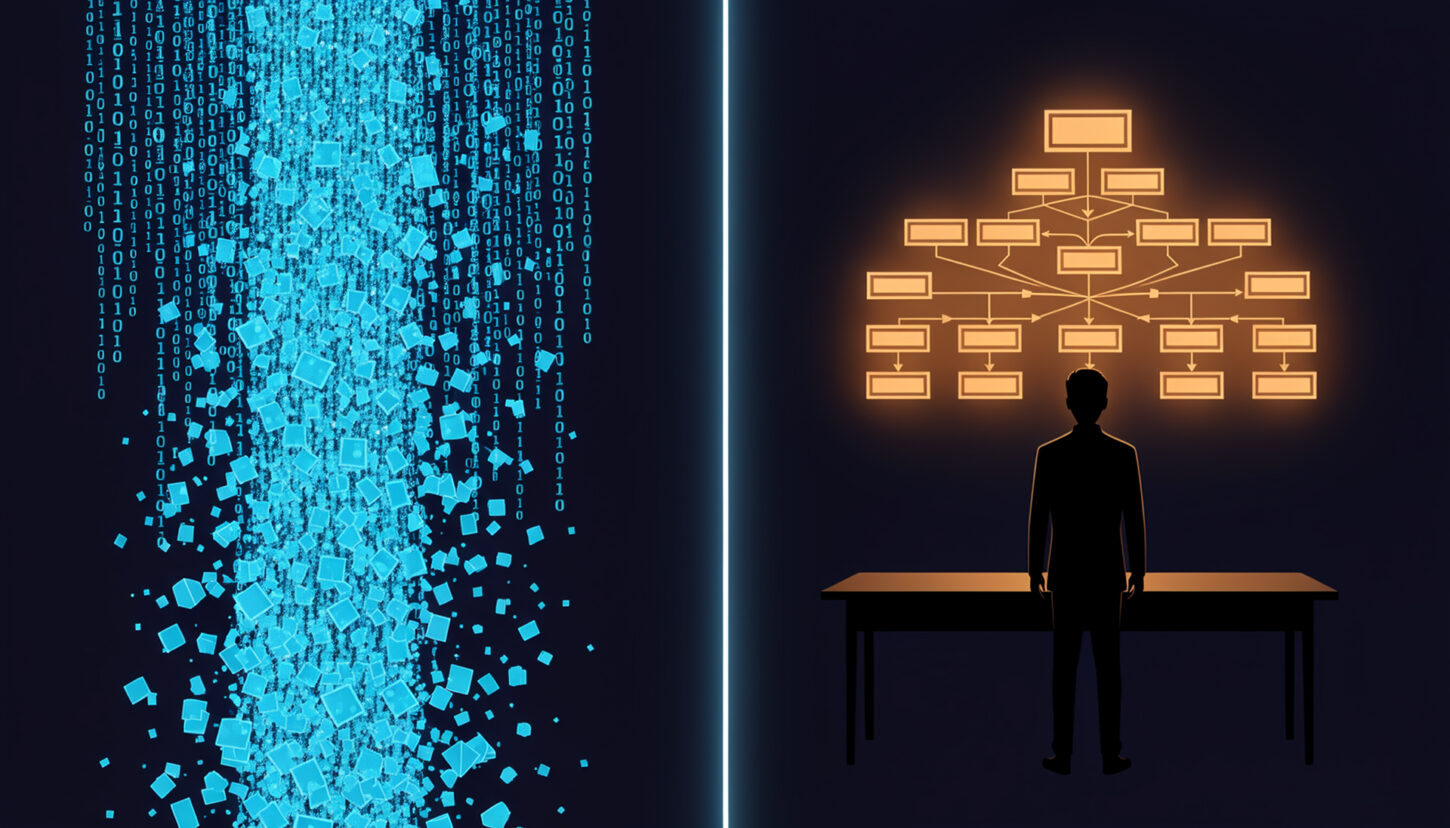
I have been writing software for more than eight years. Somewhere in the last two of those years, I started to worry.
Not loudly. Not in a way I said out loud to anyone. But it was there — that quiet, specific fear that sits underneath a lot of developers’ daily routines right now. AI could write working code. It could explain a bug faster than I could find it. It could scaffold an entire feature before I’d finished reading the ticket. And somewhere in the back of my mind, a question kept resurfacing: if it can do all of that, what exactly am I still here for?
Then I started using it every single day — not as an experiment, but as part of how I actually build software. And somewhere in that daily practice, the fear didn’t disappear. It just changed shape. I realized I had been afraid of the wrong thing entirely.
The myth: “AI can write code, therefore AI replaces developers”
This is the sentence sitting underneath almost every anxious conversation developers have about AI right now. It sounds logical. It is also wrong, and it’s wrong in a specific, useful way once you actually sit with it.
AI didn’t replace developers. It did something narrower and more disruptive: it commoditized execution.
Writing the code, scaffolding the boilerplate, producing a first working draft of a function — that part of the job is now cheap, fast, and available to almost anyone who can describe what they want clearly. That’s not a small thing. It’s a real shift. But it is also not the same thing as replacing the job.
Because the job was never just execution. Execution was simply the part of the job that was easiest to see.
The SaaS thought experiment that changed how I think about this
Here’s a scenario I keep coming back to, because it strips the abstract argument down to something concrete.
Say you ask an AI model for a business idea. It gives you one — a reasonably good one, tailored to a niche you described. You ask it to build the product. A few hours later, you have a working SaaS application. Functional. Deployed. You’re proud of it, and you should be — that used to take weeks.
Now ask yourself the harder question: who is going to use it?
Because here’s the part that’s easy to skip past — that same AI can give the exact same idea and build the exact same product for anyone else who asks a similar question this week. Not a worse version. Not a rough copy. The same idea, the same execution, the same hours.
If the only thing standing between an idea and a working product is a prompt and a few hours, then the product itself stopped being the differentiator. Speed of execution used to be a moat. It isn’t one anymore — not because it got harder, but because it got available to everyone at once.
What’s left after execution becomes free? The decision about what to build, for whom specifically, and why it matters to that exact group of people in that exact context. That decision is judgment. And judgment is not something you can prompt your way into, because it depends on context the model was never given — your market, your users’ actual unstated problems, the tradeoffs your specific business can and can’t afford to make.
That’s the part nobody can copy in the same five minutes it took to copy the build.
The junior-hiring myth, and what actually happened
There’s a related myth that’s done a lot of damage to how people talk about this, and it’s worth taking apart with real numbers instead of vibes.
The popular narrative went something like this: AI can handle simple, repetitive coding tasks, so companies stopped hiring junior developers to do them. Plenty of companies acted on exactly that logic over the past couple of years.
Here’s what happened next.
A Robert Half study found that 29% of companies that laid off workers after implementing AI ended up rehiring them — a trend now widely referred to as “AI boomerang” hiring. Forrester’s 2026 Future of Work report went further, estimating that 55% of employers regretted laying off workers for AI-related reasons. Among companies that walked back AI-driven layoffs, more than a third rehired over half the people they’d let go — and 1 in 3 of those companies ended up spending more on restaffing than they had originally saved by cutting the roles in the first place.
Why did this happen? Because execution without judgment created exactly the quality gap you’d expect. One industry survey found that 96% of developers don’t trust AI-generated code without manual review. Someone still has to be the one doing that review — understanding the codebase, the edge cases, the business risk of a subtle bug shipping to production. That’s judgment work. It doesn’t disappear just because the first draft got faster.
This doesn’t mean entry-level developers are suddenly safe by default, and I don’t want to oversimplify that part. The bar genuinely moved. But it moved up, not away — junior roles now expect people to bring more judgment, earlier, than before. Several 2026 hiring surveys found that over half of companies actually plan to increase senior positions going forward, precisely because someone has to supply the judgment that AI-generated execution still can’t supply for itself.
The myth said AI shrinks the need for human developers. What actually happened is more specific: it shrank the value of execution alone, and raised the value of everything else.
What AI is actually good at, in my day-to-day work
I don’t think abstract arguments about AI are very convincing on their own — including the ones I just made. So here’s what this actually looks like in my own daily work, using AI as a working tool rather than a replacement for my judgment:
- Boilerplate and repetitive scaffolding — the parts of a feature that are necessary but not where the thinking happens.
- Debugging across unfamiliar or shifting APIs — when I’ve had to track down breaking changes in WordPress’s internal media library JavaScript across several major versions, AI has been genuinely useful at narrowing down where something broke faster than I could alone.
- A second pair of eyes in code review — catching things I’m too close to the code to notice.
- Compressing research time — getting me to the actual decision point faster, instead of spending an hour reading documentation before I can even start deciding anything.
- Drafting first passes — of functions, of structure, of approaches — that I then reshape with context the model was never given in the first place.
None of this replaced my judgment. All of it gave me more time to spend on judgment. That distinction is the entire argument.

What judgment actually looks like in practice
It’s easy to use the word “judgment” as a vague placeholder — the thing humans supposedly still have that AI doesn’t. So let me make it concrete instead of philosophical.
Judgment is knowing that a technically correct architecture suggestion is still the wrong one for a specific business, because it ignores a constraint the model was never told about — a legacy system it has to integrate with, a team that can’t maintain that level of complexity, a deadline that makes the “ideal” solution the wrong solution right now.
Judgment is understanding what a user actually needs, which is frequently different from what they typed into a ticket. AI can execute the ticket exactly as written. It can’t tell you the ticket was solving the wrong problem.
Judgment is knowing which performance optimization actually matters to your specific users versus which one only matters on a benchmark. It’s understanding the difference between code that works and code that will still make sense to the next engineer who touches it in a year.
This is the part of the job that was never about typing speed, and it’s the part that doesn’t get cheaper just because everything around it did.
The real takeaway
The fear I started with — that AI would make developers obsolete — was built on a reasonable observation pointed at the wrong target. AI didn’t threaten the job. It threatened the narrowest possible definition of the job, the part that was always going to be the easiest to automate eventually.
What’s actually at risk isn’t “developers” as a category. It’s anyone whose value was only execution, with no judgment behind it — because that part is now available to everyone, instantly, for free.
I use AI every day. It hasn’t replaced me. It’s removed the friction between having an idea and testing it, between hitting a bug and understanding it, between a first draft and a better one. That’s not a smaller job. It’s the same job, with more room in it to actually do the part that mattered all along.
That’s the real reason I stopped being afraid. Not because AI turned out to be weaker than I thought — but because I finally understood what it was actually competing with. And it wasn’t me.
If you’re a developer thinking through the same question, I’d genuinely like to hear how you’re seeing this play out in your own work — drop a comment or reach out.
Write a Comment